


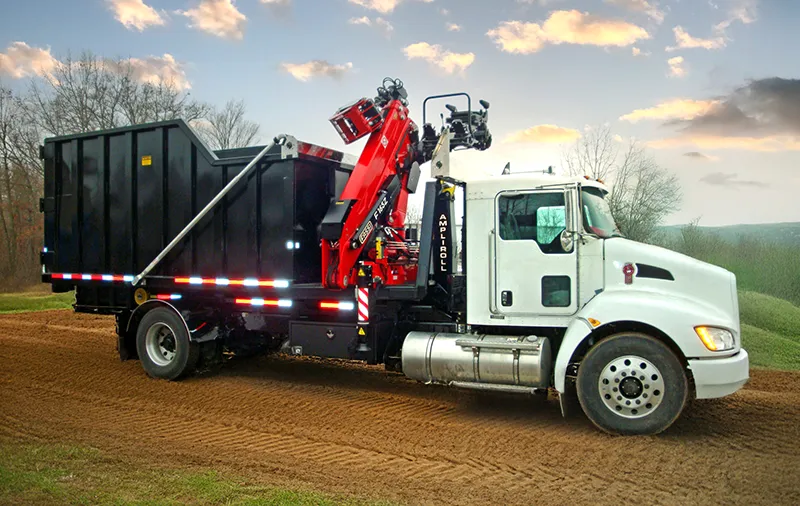
Few innovations have reshaped the commercial trucking industry as quietly, yet as profoundly, as the hooklift system. Today, hooklift trucks are everywhere: hauling waste at construction sites, transporting septic tanks, carrying water tankers to wildfire zones, and servicing municipal fleets across the country. But understanding where the hooklift came from helps explain why it remains the most versatile load-handling solution on the market.
Post-War European Origins
The hooklift system was born out of necessity in post-war Europe during the late 1950s and early 1960s. As European economies rebuilt their infrastructure, the need for efficient, multi-purpose trucks became critical. Labor was expensive, equipment was scarce, and operators needed trucks that could do more than one job. French engineering firm MARREL–the company behind the AMPLIROLL® system–pioneered the roll-on/roll-off concept, developing a hydraulic arm mechanism that allowed a single truck to exchange bodies on the ground without cranes or additional equipment. The name “hooklift” describes exactly what it does: a hook that lifts interchangeable containers onto and off of a truck frame.
Crossing the Atlantic
The hooklift concept spread through Europe throughout the 1970s and began making its way to American shores by the late 1970s and early 1980s. Marrel Corporation introduced the AMPLIROLL® USA Hooklift System to the United States market in 1980, bringing with it decades of European engineering refinement. American fleet operators quickly recognized what their European counterparts already knew–a hooklift truck could eliminate the need for multiple dedicated vehicles by swapping bodies in minutes. A single truck could serve as a dump truck in the morning, a flatbed in the afternoon, and a liquid tanker the next day.
From Niche Tool to Industry Standard
Through the 1990s and into the 2000s, hooklift systems transitioned from a specialized European import into a mainstream staple of American commercial fleets. The waste management, construction, and municipal industries led adoption, drawn by the operational efficiency and cost savings that hooklifts delivered. Advances in hydraulic technology made systems more reliable, faster, and capable of handling heavier payloads. Manufacturers refined the hook-and-rail interface, improving safety and load stability at every stage of the lift cycle. Over time, the hooklift stopped being seen as an upgrade and started being recognized as the smarter baseline configuration for medium-duty and heavy-duty trucks.
The Modern Hooklift System
Today’s hooklift systems offered by AMPLIROLL® USA carry lifts ranging from 13,000 to 65,000 pounds and are engineered for a service life exceeding 25 years. Modern hooklifts feature ground-level loading for safer operation, precision-fit jib designs that eliminate plastic and steel shims, and straightforward hydraulic controls that reduce operator training time. The range of compatible roll-off bodies has expanded dramatically, from aerial lifts and cranes to water tankers and septic pumpers, making the hooklift truck more capable than ever. What began as a clever post-war workaround in France has become the backbone of efficient fleet operations across the United States–and all modern hooklift designs trace back to those original AMPLIROLL® designs.
AMPLIROLL® USA is the only supplier in the United States of premier hook loader systems and associated equipment. Unlike many others, we can offer a complete selection of truck-mounted accessories and roll-on/off bodies as a package with your AMPLIROLL® USA hook loader. Being your single source of acquisition has its advantages!
Additionally, you can choose from our selection of new and used hooklift vehicles.
Deal maker Andy Jansma from AMPLIROLL® USA can answer all your questions, with over 30 years of experience integrating hook loaders and truck bodies to the proper chassis.